
In any real estate transaction—whether involving a residential flat, independent house, plot of land, or commercial property—legal documentation plays a decisive role. Among the many documents exchanged during a property deal, two hold primary importance: the Agreement to Sale and the Sale Deed.
A common misconception among buyers and sellers is that these two documents serve the same purpose. In reality, they operate at different stages of the transaction and carry very different legal consequences. One reflects a future commitment, while the other confirms the actual legal transfer of ownership. Confusing the two often leads to disputes, loan complications, and ownership conflicts.
This guide explains:
-
The meaning of an Agreement to Sale
-
The meaning of a Sale Deed
-
Their legal relevance
-
Key differences between the two
-
Real-world risks and practical application
Whether you are buying, selling, investing, or advising, this distinction is critical for your financial safety and legal protection.
What is an Agreement to Sale?
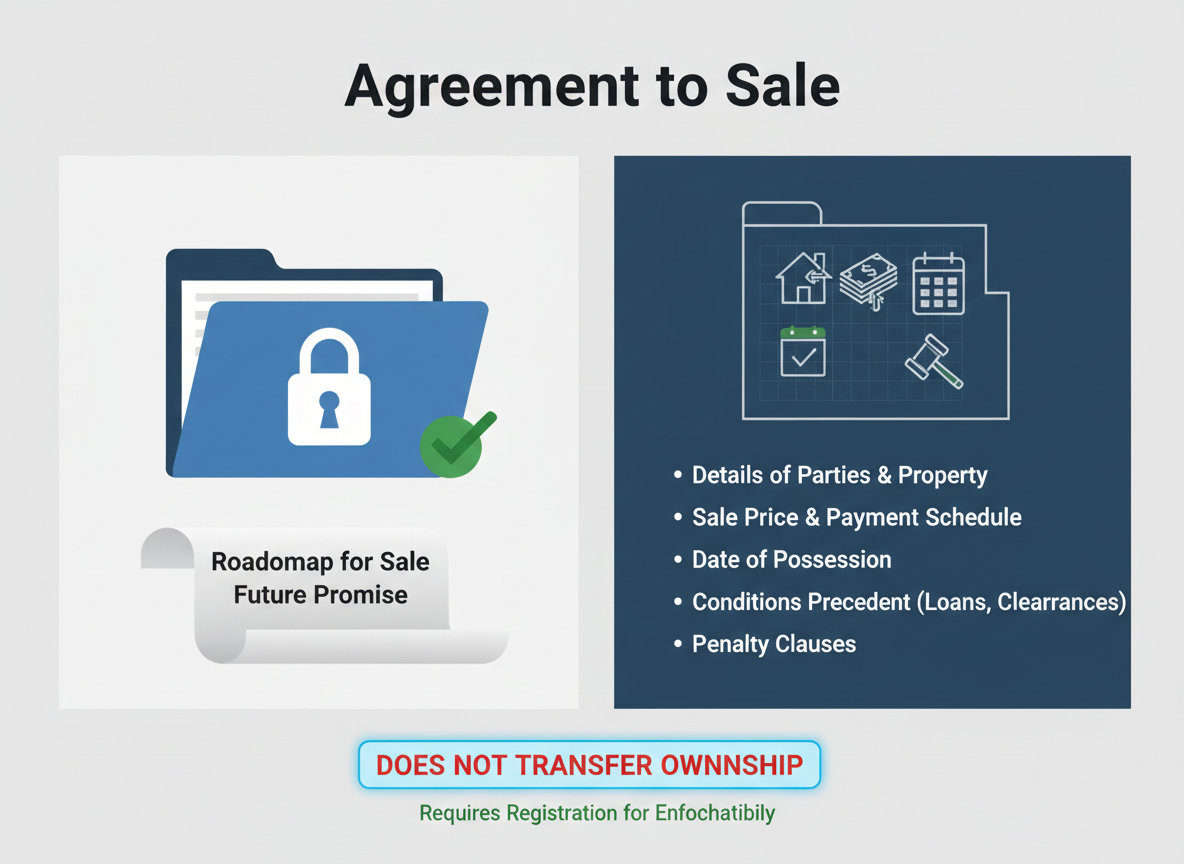
An Agreement to Sale is an initial contract that records the mutual intention of the buyer and the seller to complete a property transaction at a later date. The actual sale is dependent on the completion of specific conditions agreed upon by both parties.
These conditions generally include:
-
Sanction of a housing loan
-
Legal verification of the property
-
Mandatory government approvals
-
Staged or milestone-based payments
From a legal standpoint, this agreement does not transfer ownership. Instead, it creates a binding responsibility on both sides to complete the deal in the future.
Key Features of an Agreement to Sale
-
It reflects a future obligation, not a completed transaction
-
Clearly defines the sale price, payment schedule, possession date, and conditions
-
May be registered or unregistered (registration strengthens legal validity)
-
Does not grant ownership rights
-
Gives the buyer the right to seek court enforcement if the seller withdraws unfairly
Practical Illustration
Mr. Sharma decides to buy Ms. Kapoor’s flat for ₹60 lakhs. Since his loan is still under processing and the seller has some pending dues, they sign an Agreement to Sale. At this stage, Ms. Kapoor continues to remain the legal owner.
What is a Sale Deed?
A Sale Deed is the final legal instrument that completes the property transaction. Once it is executed, properly stamped, and registered, ownership officially shifts from the seller to the buyer.
In legal terms, a registered Sale Deed is the strongest and most conclusive proof of property ownership.
Key Features of a Sale Deed
-
It confirms that the transaction is fully executed
-
Legal ownership is transferred to the buyer
-
Registration is compulsory under the Registration Act, 1908
-
Records the final sale value, date of transfer, and indemnity protections
-
Required for loan disbursement, mutation, resale, and insurance
Practical Illustration
After loan approval and payment completion, Mr. Sharma and Ms. Kapoor register the Sale Deed at the Sub-Registrar’s office. From that day onward, Mr. Sharma becomes the lawful owner of the property.
Key Differences Between Agreement to Sale and Sale Deed
| Point of Comparison | Agreement to Sale | Sale Deed |
|---|---|---|
| Nature of Document | Future commitment | Final execution |
| Legal Status | Executory contract | Executed contract |
| Ownership Rights | Not transferred | Fully transferred |
| Registration | Optional but advisable | Mandatory |
| Legal Proof | Not valid ownership proof | Conclusive legal proof |
| Use in Banking | Loan application stage | Loan disbursement stage |
| Mutation | Not allowed | Mandatory |
Legal Standing Under Indian Law
Transfer of Property Act, 1882
Section 54 states that a sale is complete only when ownership is transferred for a price. A mere agreement becomes an actual sale only after a registered Sale Deed is executed.
Registration Act, 1908
Section 17 makes registration compulsory for property transfers. Without registration, legal ownership is not recognized.
✅ Legal Summary:
An Agreement to Sale creates a legal obligation, whereas a Sale Deed creates legal ownership.
Role in Real Estate Transactions
Purpose of Agreement to Sale
-
Confirms buyer-seller intent
-
Used for home loan processing
-
Allows time for legal verification
-
Supports RERA compliance and society approvals
Purpose of Sale Deed
-
Completes the ownership transfer
-
Enables municipal mutation
-
Mandatory for bank loan release
-
Required for resale and insurance coverage
Common Clauses Found in Both Documents
-
Property location and boundaries
-
Details of buyer and seller
-
Total consideration value
-
Payment schedule
-
Indemnity protection
-
Possession timeline
Risks of Misunderstanding These Documents
If a buyer assumes an Agreement to Sale guarantees ownership, the following risks arise:
-
Money paid without legal title
-
Property may be resold to another buyer
-
Home loan may be rejected
-
Mutation may get blocked
-
Long and expensive legal disputes
Real-World Scenarios
❌ Case 1: Delay in Registration
Ravi pays 70% after signing the Agreement to Sale but delays registration. The seller resells the property. Ravi is forced into court proceedings.
✅ Learning: Payment and agreement alone do not give ownership.
✅ Case 2: Proper Legal Process
Sneha completes legal checks, arranges finances, and registers the Sale Deed on time. Ownership transfers smoothly.
✅ Learning: Legal discipline protects investment.
Best Practices for Buyers and Sellers
-
Never treat an Agreement to Sale as ownership proof
-
Always register the Sale Deed without delay
-
Get documents legally vetted
-
Add penalty clauses for defaults
-
Preserve registered documents for taxation and resale
Final Perspective
From both a legal and business standpoint:
-
Agreement to Sale = Commitment
-
Sale Deed = Ownership
No matter how large the payment, ownership does not exist without a registered Sale Deed. A safe property transaction always follows this sequence:
-
Agreement to Sale
-
Registered Sale Deed
Understanding this distinction is essential for wealth protection, legal security, and long-term asset stability.




Join The Discussion